You pull out one charging cable. Two more follow it, wrapped around a plug you did not need. The problem is not necessarily a shortage of pockets. Sometimes the cables simply need to stop borrowing one another’s space.
The Nite Ize Original Gear Tie offers a straightforward approach: a rubber-covered, bendable wire you wrap around a bundle and twist closed. Open it again when you need the cable. No cutting a disposable zip tie and no elaborate organizer to unpack.
Our take: useful for repeatedly handled small bundles, but not automatically better than a hook-and-loop strap. Start with the cables you use, their packed shape and how often you unwrap them. This is researched guidance, not our durability or travel test. Our product page contains an Amazon.com paid link. As an Amazon Associate I earn from qualifying purchases.
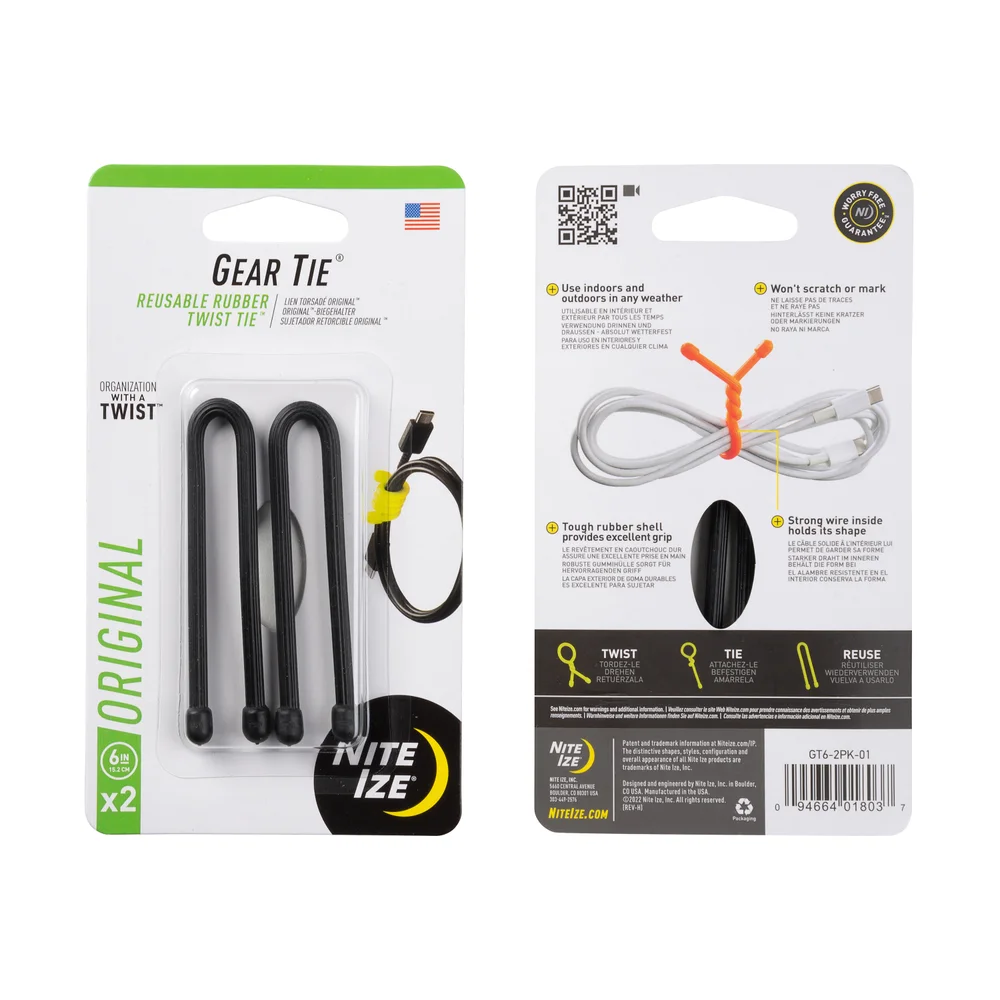
Measure the bundle, not the cable
“Six-inch” describes the tie’s length. It does not describe the cable it can organize. A short, thick cable may make a larger bundle than a longer, thinner one, and large connectors can change how neatly it coils.
Lay your cable in a relaxed shape without forcing a tight bend at either connector. Look at the thickness where the tie would go. The tie needs to wrap around that section and leave enough length to close; a fit that only works when you crush the coil is not a useful fit.
Nite Ize positions its six-inch version for medium-to-long cords, but your bundle is the relevant test. If ordering without a try-on, compare the manufacturer’s sizes against the actual packed bundle and leave room for the closure. Do not translate a marketing example into a universal fit promise.
Where a Gear Tie earns its place
Think of a cable you remove from a bag every day: phone charging at work, a headset after a call, or a spare charging lead during a trip. The benefit is a repeatable little package that separates from the rest of your kit.
The tie does not have to make the whole pouch look perfect. It only needs to stop one frequently used cable from tangling with another. Tie those high-use items individually first. If the remaining spares sit quietly in a pocket, they may need no new accessory at all.
Avoid turning several different leads into one giant bundle merely because a tie can close around them. That restores the original inconvenience: every time you want one cable, you unpack the entire collection. Organize by the moment of use rather than by visual symmetry.
Gear Tie versus hook-and-loop straps
The Gear Tie holds a shape with its wire core; a hook-and-loop strap closes by fastening its surfaces together. That distinction matters more than deciding that one material is universally superior.
A flat strap can be a sensible fit for a slim pouch or a cable that already came with an attached keeper. A shaped tie can be appealing when you want an easily reopened wrap around a modest, irregular bundle. We have not measured their grip, speed or lifespan head to head, so this is a design comparison, not a test ranking.
If you already own reliable straps, do not replace a working system for consistency’s sake. Try a different tie only on the bundle that causes trouble. Mixed organizers are perfectly reasonable when your cables are different.
A disposable zip tie serves a different purpose. It is less convenient for a travel cable that must be opened repeatedly, and cutting near a cable adds an unnecessary step. That does not make a reusable Gear Tie a substitute for properly specified permanent installation hardware.
The pack quantity is part of the decision
The linked Amazon variant is a black six-inch twelve-pack. Twelve is useful only if you can name enough jobs for them. Count the cables that actually need management before comparing offers. Someone carrying one phone lead and one charger may be better served by a smaller pack or existing keepers.
All-black ties also provide no color-coding system. If identifying different people’s cables is the main goal, labels or clearly distinguishable organizers may address that problem more directly. Keeping cables together and telling cables apart are related, but they are not the same task.
Original Gear Ties and the Cordable range are not interchangeable names. Cordable versions have a different attachment arrangement. Verify the specific design rather than ordering from the first familiar-looking photograph.
Keep the job modest
The manufacturer explicitly says the product is not weight rated and warns against sharp edges, hot or abrasive surfaces, and shifting loads. We therefore recommend it here for organization, not for suspending valuable equipment or restraining a load in transit.
Do not use a neat-looking cable bundle as a reason to ignore the cable or appliance maker’s instructions. In particular, the tie is not an electrical protection device, a strain-relief repair, or a remedy for damaged insulation. A worn cable should not be disguised inside a tidier coil.
Inspect a reused tie for damage and stop using it if the covering or core is compromised. “Reusable” means it can be reopened; it is not a promise of indefinite service. We have not performed cycle testing.
A less tangled packing routine
Before your next trip, empty the tech pouch and separate daily-use cables from backups. Remove obsolete leads. Coil each remaining cable comfortably, then use a keeper only where it prevents an actual tangle.
Put the lead you reach for most in an accessible position. Leave the connector easy to identify. Open and repack the pouch once: can you retrieve that lead without loosening everything else? This small rehearsal tells you more about the arrangement than an attractive flat-lay photograph.
You may discover that you need fewer ties than expected—or a smaller pouch. That is a successful result. The point is quicker access, not filling every compartment with another organizing product.
Which cable keeper fits your routine?
| Option | Most relevant when | Check first |
|---|---|---|
| Original Gear Tie | You repeatedly open a modest cable bundle | Tie length, closure room and pack quantity |
| Hook-and-loop strap | Flat packing matters | Whether the strap you already have works |
| Existing attached keeper | One cable needs its own organizer | No extra purchase may be needed |
| Disposable zip tie | A suitable installation calls for it | Not convenient for daily unpacking |
The verdict
The six-inch Gear Tie is a credible shortlist option for cables that are constantly packed and unpacked. Its case is weaker for an already tidy kit, a very flat organizer, or a job that needs a rated restraint.
Check the bundle size, count how many ties you will use, and compare a simple strap before committing to the twelve-pack. See our Gear Tie product notes and the selected Amazon.com variant. Seller, delivered cost and returns must be checked at the retailer; a US shopping link is not a promise of local availability worldwide.