You leave the hotel without a backpack. Then the sunglasses come off, your phone needs charging, and the jacket with all the useful pockets suddenly feels too warm. Nothing you are carrying is large. Together, though, those little things have become a job for your hands.
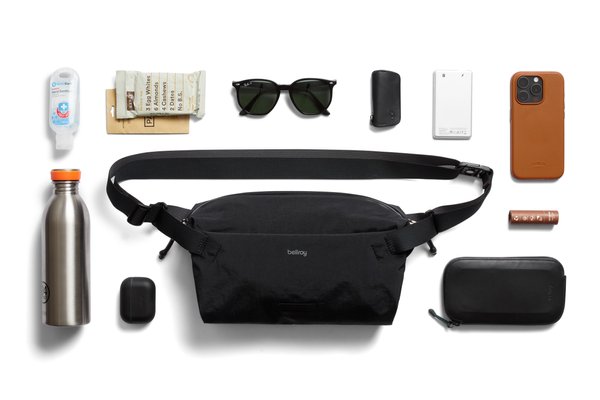
That is the strongest case for the Bellroy Lite Sling: somewhere to put the small essentials you want nearby without committing to a full daypack. It is a conditional recommendation. A light, modest load suits the idea; a heavy bottle, a camera and a collection of backup gadgets can undermine it.
This is a researched buying guide, not a personal travel diary or a hands-on review. The photographs are Bellroy’s, and the packing examples below are planning exercises. Our product page includes an Amazon.com paid link and an ordinary Bellroy direct link. We may earn a commission from qualifying Amazon purchases.
The bottle is the decision—not the phone
A phone and a slim wallet rarely explain why someone needs a larger sling. The awkward item does: a rigid sunglasses case, a compact umbrella, a camera or a water bottle. Choose that item first and the rest of the decision becomes easier.
Bellroy identifies this as the 7L Lite Sling, distinct from the Mini. Think of that capacity as a category label, not a promise that seven liters of your possessions will pack neatly. A curved, soft bag does not allocate its space like a rectangular drawer. Two people can carry the same number of items and need very different amounts of room.
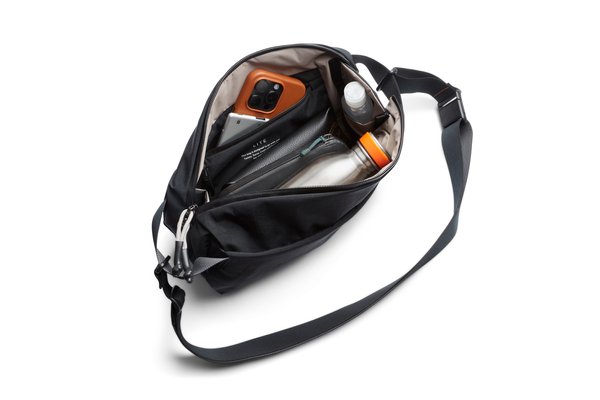
Try this before ordering: put tomorrow’s essentials on a table and remove anything you carry only because a larger bag lets you. Then put the non-negotiable rigid items together. Does your bottle need almost the entire length of the proposed bag? Will your glasses still need a protective case? Can you take out your phone without taking something else out first?
If drinking water is the main reason for carrying a bag, a small backpack with a bottle pocket may be the more sensible starting point. A sling should simplify access, not make every sip a packing exercise.
Expansion helps—but it isn’t permission to overpack
The Lite Sling’s gusset changes the bag’s depth as the load changes. Bellroy also describes an opening that unzips from either end. Those features are relevant to a stop-start day: leaving with a light load, adding a small purchase, then removing a layer later.
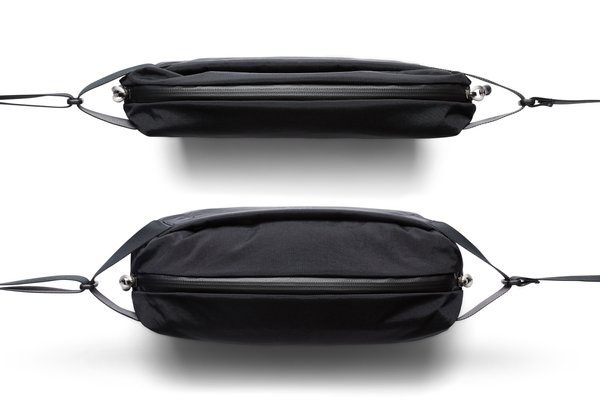
Our judgment is that this flexibility is most useful when your load varies a little. It is less compelling if you know you will fill every corner before leaving home. Expansion creates space; it does not remove weight or make a hard object softer against your body.
Build in an access margin. Leave enough room to put your hand beside the contents and retrieve the thing you use most. If everything must be nested in a precise order, you have packed a storage container rather than a convenient day bag.
Give the keys a home and the phone a clear route
The front compartment includes a key clip. That is a small feature with a specific job: keeping a tiny, frequently needed object from disappearing into the larger space. Do not assume the adjacent pockets will accept every phone, wallet or power bank simply because those objects are small.
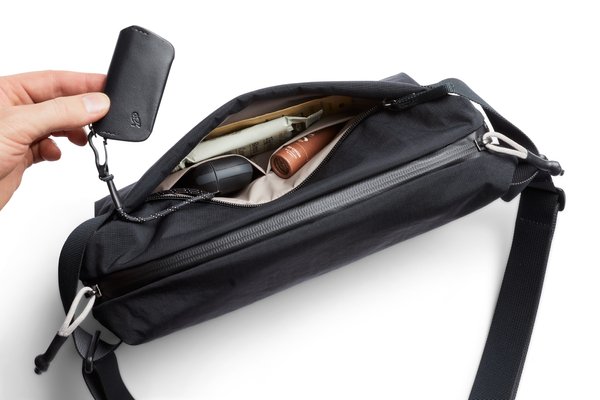
For a hypothetical city outing, give the phone the easiest route out, isolate keys from scratch-sensitive items, and group charging accessories only if that group earns its space. Our Tech Kit guide explains the trade-off with a dedicated organizer. A full tech pouch inside a small sling can be an unnecessary bag-within-a-bag; one tied cable may be enough.
There is a useful independent caution here. Pack Hacker’s earlier Lite Sling review found the front organizer pockets awkward for some everyday objects and flagged the openings near the gussets as a concern. Those are its observations about its sample, not our test results or proof that every current edition behaves identically. They are good reasons to inspect pocket layout and closure coverage before choosing a version.
A clever clasp still has to work on your body
Bellroy lists a magnetic strap clasp. The photograph below shows how the strap separates, which may be useful when taking the bag off without lifting it over your head. What it cannot establish is whether the buckle lands comfortably on your shoulder or is easy for you to reach.
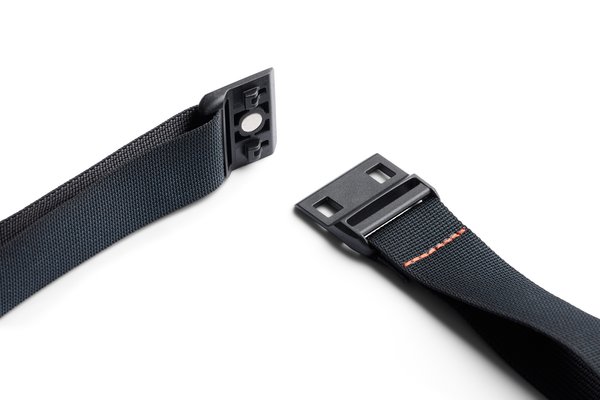
If trying it in a shop, load your real essentials, wear it on your usual side, sit down and reach for your phone. Try the clasp while wearing the kind of layer you travel in. Online, check strap adjustment information and the return conditions before treating a product photograph as a fit recommendation.
We would not choose a sling on empty weight alone. The weight of what you carry and the time spent carrying it are at least as important. For long walks with a dense load, consider two shoulder straps instead.
What would make us choose something else?
A laptop or protected camera kit: start with a bag designed around that equipment. Soft organization is not protective padding.
Very little to carry: a smaller pouch or your existing pockets could solve the problem without the cost and bulk of this sling.
Heavy rain or water exposure: a water-resistant zipper is not evidence of a sealed waterproof bag. Do not rely on this guide as a promise to protect electronics from soaking.
An already useful small backpack: keep it unless you can name the inconvenience a sling would remove. Buying a different silhouette is not necessarily a practical upgrade.
A five-minute check before you order
Put your usual city-day essentials on a table, with the things you actually carried yesterday separated from the things you might carry once a month. Keep the largest rigid object in the first group: a bottle or glasses case cannot borrow space from a phone the way a soft jacket can.
Now imagine three stops: a ticket gate, a café counter and a bench where you take off a layer. What must come out at each stop? If retrieving a ticket means unloading a bottle, the arrangement needs work. If adding the layer turns a light essentials bag into an overfilled sack, start with a small backpack instead.
This exercise does not establish that the Lite Sling fits your load. It gives you a precise question to take to the retailer or answer during a permitted try-on. Check the selected version and return conditions before ordering; do not buy a larger packing problem just to empty your pockets.
The verdict: buy back your hands, not more carrying capacity
The Lite Sling makes sense when your essentials have outgrown your pockets but your plans have not grown into a backpack day. Its appeal is the combination of flexible space and nearby access—not carrying the largest possible inventory on one shoulder.
If that describes your routine, see the Lite Sling product notes and current retailer options. Compare the exact edition’s layout with your largest item before buying. If your first instinct is to add a second bottle and several backups, that is a useful answer too: you may need a different kind of bag.