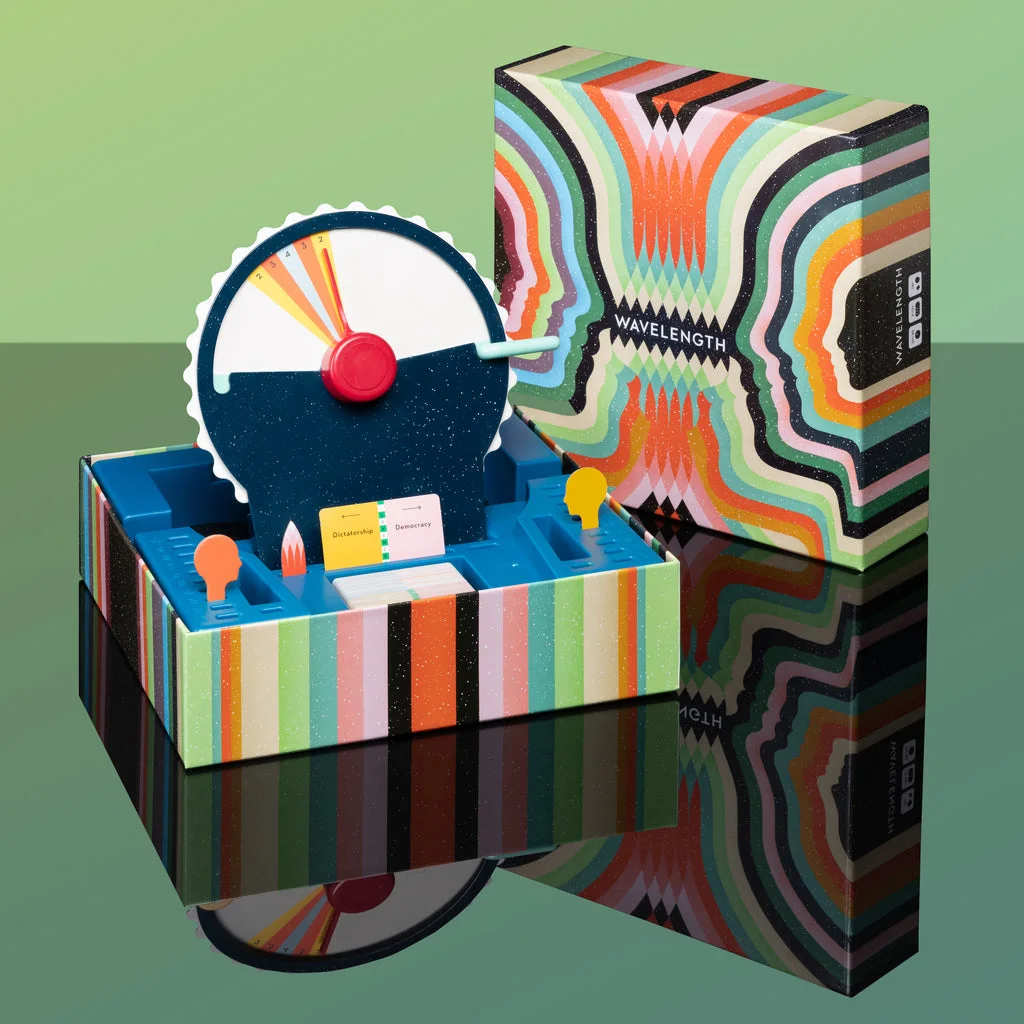
One person thinks a talking cat is moderately weird. Another thinks it belongs at the far end of the scale. That small disagreement is the sort of conversation Wavelength turns into a game. Instead of knowing more facts than your friends, you try to understand how they connect a clue with a position on a spectrum.
The dial gives the discussion somewhere to go
A clue-giver sees the hidden target, then offers a clue relating to the two ends of a spectrum. The team discusses where that clue belongs and turns the physical dial. Revealing the target gives the argument a payoff rather than leaving it as an endless debate over definitions.

The chunky device and colourful box are part of the physical version’s appeal. This is not the phone app, even though the same name appears on both. If your main interest is playing remotely, look at the app separately before buying a tabletop object that still needs people around it.

Choose the conversation, not just the headcount
The selected listing describes play for 2–12+ people and roughly 30 minutes. Those numbers do not tell you whether your group will enjoy it. The stronger fit is a gathering where people like discussing subjective ideas and can leave room for quieter players to contribute.

Shared English and cultural references matter. A clue that is obvious to one person may be meaningless to another, so choose references everyone understands rather than mistaking confusion for a lack of imagination. Very competitive players who want mostly objective, factual answers may prefer another game.
A useful test before buying
Try a harmless spectrum in ordinary conversation: practical gift at one end, impractical gift at the other. Would your group enjoy deciding where a miniature disco ball belongs? If the discussion starts naturally, you have a better reason to buy than an award badge alone. That example is ours, not a quoted game card.
Allow room for everyone to see the dial and leave the mechanism and cards clear of drinks. We have studied the game rather than hosted a test session. Choose Wavelength for the talk around the answer; skip it if the group would rather solve a puzzle quietly than negotiate what a clue means.